


In the salt lake lithium extraction industry, even a 1% difference in lithium recovery rate can translate into a resource gap measured in thousands of tons. Industry data shows that conventional evaporation concentration and certain chemical lithium extraction routes are often constrained by issues such as magnesium-lithium co-crystallization, residual lithium loss in mother liquor, and process fluctuations, resulting in overall lithium recovery rates typically ranging from 25% to 50%. Although some emerging Direct Lithium Extraction (DLE) technologies can increase recovery rates to above 70%–90%, significant differences in system stability and resource utilization efficiency still remain under complex brine conditions.
In BICHEM’s industrial-scale projects, the overall lithium recovery rate can exceed 98%. While the difference may appear to be only a few percentage points, it leads to entirely different economic outcomes in large-scale industrial operations. BICHEM has redefined the core evaluation standard for salt lake lithium extraction: the question is no longer whether lithium can be extracted, but how much lithium can be recovered and how long the system can operate stably. Our objective is singular — to maximize lithium ion retention throughout the brine processing cycle, eliminate lithium resource loss, and directly enhance project profitability for our clients.
Ultra-high recovery rates are proven through BICHEM’s industrial operation
Many lithium extraction technologies in the market are capable of extracting lithium, but the ultimate performance is determined not by a single piece of equipment, but by how effectively the entire system controls lithium loss. In practical operations, lithium loss primarily occurs in three stages: insufficient lithium selectivity caused by impurity ion interference; declining process efficiency under fluctuating operating conditions; and ineffective recovery of residual lithium remaining in mother liquor and tail streams.
Most high-recovery-rate claims in the market remain limited to laboratory or pilot-scale testing and cannot effectively adapt to the complex realities of salt lake brine operations. By contrast, BICHEM’s 98% lithium recovery rate is based on continuously verified industrial-scale operational data from large commercial projects. Supported by proprietary membrane separation mechanisms and a fully integrated closed-loop process design, every aspect of the core technology is engineered around lithium retention and recovery. BICHEM does not treat membrane technology as a standalone unit operation; instead, it has been developed into a complete systems engineering platform covering pre-treatment, separation, purification, and recovery. Through coordinated front-end and back-end process control, the system maximizes overall lithium resource utilization.
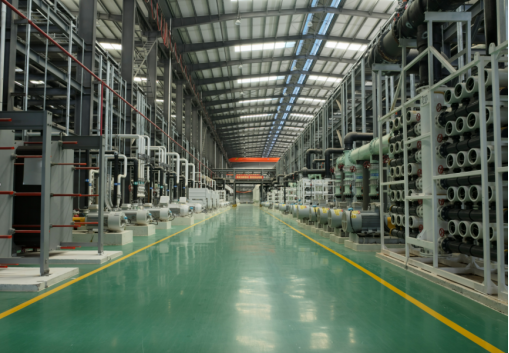
BICHEM’s membrane process plant
Three core membrane technology mechanisms behind the 98% recovery rate
1. High-selectivity membrane screening mechanism enables active separation
Unlike conventional processes that rely on passive lithium enrichment through natural evaporation, BICHEM utilizes differences in ion size and charge characteristics to develop customized functional membrane materials and establish directional lithium-ion transport channels. The system enables rapid and selective lithium-ion permeation through membrane modules while comprehensively rejecting high-interference impurity ions such as magnesium, calcium, boron, and silica. This fundamentally resolves industry-wide challenges including magnesium-lithium co-crystallization and residual lithium in mother liquor, minimizing lithium loss from the very first separation stage.
2. Multi-stage closed-loop process minimizes hidden lithium loss
Within the BICHEM system, the entire membrane-based process operates through a progressive closed-loop production configuration with zero lithium-bearing liquid discharge throughout the process, fundamentally eliminating lithium resource waste associated with conventional mother liquor discharge. During the first stage, lithium ions undergo primary concentration while the majority of impurities are removed. In the second stage, resin-coupled deep purification eliminates residual trace impurity ions, preventing impurity entrainment and associated lithium loss. In the third stage, reverse osmosis enables targeted concentration while all downstream product water and lithium-containing mother liquor are fully recycled back into the front-end process for reuse. The entire workflow achieves 100% closed-loop utilization of lithium resources, ultimately delivering a stable overall recovery rate of 98%.
3. Five supporting advantages make high recovery rates sustainable
All of BICHEM’s supporting advantages are designed to ensure long-term recovery rate stability rather than serve as isolated selling points. First, high ion selectivity minimizes impurity ion competition and maintains long-term separation accuracy without performance degradation. Second, the continuous operation model eliminates the fluctuations associated with conventional batch production, ensuring stable recovery performance year-round. Third, low reagent consumption and low energy demand reduce lithium loss caused by chemical agents while lowering operational and maintenance costs. Fourth, strong adaptability to varying operating conditions allows the system to dynamically process brines with different magnesium-to-lithium ratios while maintaining ultra-high recovery rates across both high-grade and low-grade brine resources. Fifth, the modular integrated design enables rapid integration with existing customer production lines, upgrading recovery efficiency without requiring large-scale infrastructure modifications.
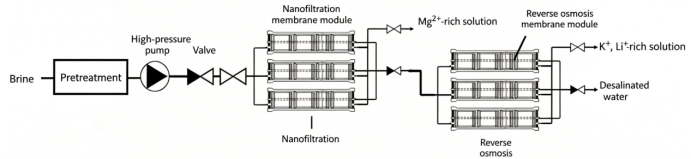
Membrane Process Flow Diagram
Conclusion
In large-scale salt lake resource development, differences in lithium recovery rates are generating exponentially amplified impacts. For million-ton-scale brine processing projects, even a 1%–2% improvement in efficiency can translate into substantial increases in resource recovery and long-term economic value. The salt lake lithium extraction industry is transitioning from an era focused on whether lithium can be extracted to one centered on how much lithium can ultimately be recovered. Future competition will no longer depend solely on process routes, but on which technologies can achieve higher resource utilization efficiency from the same brine resource.
BICHEM’s membrane lithium extraction technology continues to focus on an industrially verified lithium recovery rate of 98% as its core benchmark. Supported by proprietary membrane material development, a fully integrated closed-loop process, and multi-condition operational adaptability, the system addresses three critical challenges of conventional lithium extraction technologies: high lithium loss, insufficient production efficiency, and extended investment payback periods. Looking ahead, BICHEM will continue advancing the integration and innovation of membrane technologies with diversified process solutions, further strengthening overall systems engineering capabilities. Through continuous improvements in process integration and industrial-scale engineering performance, BICHEM remains committed to providing global clients with more efficient, stable, and sustainable pathways for salt lake resource development.
