


With the rapid development of the global new energy industry, demand across the lithium battery value chain continues to rise, making salt lake resources a major source of incremental lithium supply worldwide and a critical resource foundation for the development of the new energy sector. However, among numerous salt lake lithium extraction projects, the factor that truly constrains lithium extraction efficiency and undermines project economics is not the lithium content of the salt lake itself, but the large quantity of magnesium present in the brine.
At present, the magnesium-to-lithium ratio in most salt lake brines commonly reaches 20:1 or 50:1, while some resources even exceed 100:1. Due to the highly similar hydrated radii and chemical properties of magnesium and lithium ions, their separation is extremely challenging. Conventional lithium extraction processes require substantial consumption of chemical reagents such as acids, alkalis, lime, and soda ash. This not only results in high energy consumption and complex process flows but also causes lithium losses and generates large volumes of solid and liquid waste, significantly increasing environmental pressure and overall operating costs. Therefore, an efficient, economical, and stable magnesium-lithium separation technology is a critical determinant of the competitiveness and return on investment of salt lake lithium extraction projects.
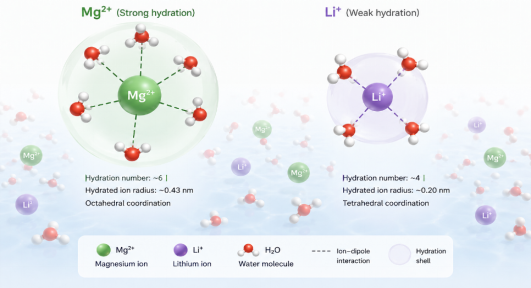
Microstructure of Mg²⁺and Li⁺ions
The value of efficient magnesium-lithium separation extends beyond magnesium removal
BICHEM's high-pressure nanofiltration (NF) technology is a magnesium-lithium separation solution with significant industrial application value for high magnesium-to-lithium ratio salt lake resources. Leveraging customized membrane materials, modularized components, and intelligent control systems, the technology combines the charge-based sieving effect and selective ion permeation mechanism of membranes to precisely reject divalent magnesium ions while allowing monovalent lithium ions to pass under high-pressure operation, simultaneously achieving impurity removal and lithium enrichment.
For industrial-scale projects, simply removing magnesium ions is not sufficient to demonstrate technological value. The key lies in maximizing lithium retention while achieving highly efficient magnesium removal. Through continuous membrane material optimization and process parameter refinement, the BICHEM high-pressure NF system consistently achieves magnesium rejection rates exceeding 95%, with performance surpassing 98% under favorable operating conditions. At the same time, lithium ion permeability remains between 85% and 95%, enabling an overall lithium recovery rate of more than 98%, thereby ensuring efficient lithium retention while effectively removing magnesium.
For salt lake projects, the significance of these figures extends far beyond higher separation efficiency. The higher the magnesium rejection rate, the lower the impurity load entering downstream process systems. Brine treated by high-pressure NF can significantly reduce the consumption of adsorbents, extractants, and chemical reagents in subsequent processing stages, lower operating loads during concentration and crystallization, and reduce the risk of equipment scaling and fouling, thereby enhancing the continuous operating capability of the entire production system. Industry data indicate that the magnesium-lithium separation stage accounts for more than 30% of total operating costs. Every percentage point improvement in magnesium removal efficiency can contribute to reductions in reagent consumption, energy usage, and equipment operating costs while improving lithium utilization efficiency, ultimately generating greater economic value for complex salt lake projects.
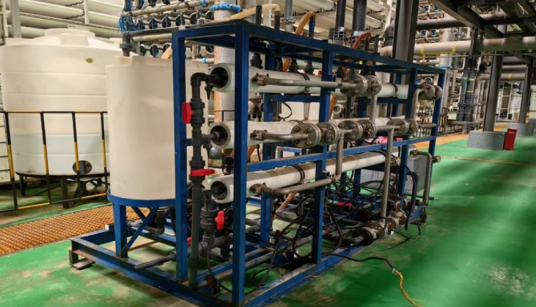
BICHEM’s nanofiltration experiment
From cost reduction to enhanced project profitability
Industry practice has shown that magnesium-lithium separation typically represents a significant portion of the overall operating cost of salt lake lithium extraction projects. Conventional chemical magnesium removal processes often rely on large quantities of lime, soda ash, and acid-alkali reagents, which not only increase operating costs but also create substantial solid and liquid waste treatment burdens. In contrast, BICHEM's high-pressure NF technology achieves magnesium-lithium separation through a physical separation mechanism, significantly reducing chemical consumption and waste generation. At the same time, efficient magnesium removal at the front end reduces the load on downstream process systems, thereby lowering overall energy consumption and equipment operating costs.
For investors, high magnesium rejection rates translate into lower operating costs; for operators, high lithium recovery rates mean greater resource utilization efficiency; and for projects as a whole, they contribute to shorter payback periods and more stable long-term profitability. Fundamentally, the value created by efficient magnesium-lithium separation is not confined to a single process step but extends throughout the entire salt lake lithium extraction value chain, ultimately being reflected in overall project economics.
From resource competition to separation efficiency competition
As high-quality salt lake resources become increasingly scarce, high magnesium-to-lithium ratio and low-grade salt lakes are emerging as a key direction for future lithium resource development. The industry's competitive landscape is also evolving, shifting from competition based on resource reserves toward competition based on resource utilization efficiency. In this context, those capable of achieving precise magnesium-lithium separation at lower cost, lower energy consumption, and higher recovery rates will gain a competitive advantage in future salt lake development projects. High-pressure NF is no longer merely an auxiliary process but has become critical infrastructure within modern salt lake lithium extraction flowsheets.
Looking ahead, BICHEM will continue advancing membrane separation technologies through ongoing innovation and optimization, promoting the deep integration of high-pressure NF with membrane-based lithium extraction, electrodialysis, and lithium-rich mother liquor recovery processes. By continuously improving magnesium-lithium separation efficiency and reducing project operating costs, BICHEM is committed to helping customers worldwide unlock the value of low-grade salt lake resources. Through mature engineering capabilities, customized solutions, and long-term operational reliability, the company aims to enhance lithium resource development efficiency, product quality, and project economics while supporting the high-quality growth of the global new energy industry.
