


In the field of lithium extraction from salt lake brines, a key performance indicator that has long been overlooked, but ultimately determines project profitability, is not the recovery rate itself, but lithium loss at every stage of the process. For large-scale salt lake projects, even a 1% increase in overall recovery can translate into a difference of thousands of tonnes of lithium resources over long-term continuous operation. The real challenge lies in minimizing lithium loss throughout the entire process.
Conventional membrane-based processes can effectively achieve concentration and partial ion separation. However, when treating complex salt lake brines, they still rely heavily on resin adsorption, chemical impurity removal, and evaporation concentration processes. This not only increases operating costs but also leads to lithium loss and membrane fouling. As a result, an increasing number of lithium extraction projects are adopting membrane-coupled electrodialysis(ED)processes. Through multi-stage selective ion separation, these processes simultaneously optimize impurity control, lithium enrichment, and resource recovery. Membrane technology provides efficient concentration and pre-separation, while ED utilizes ion-exchange membranes and an electric field to achieve the precise separation of lithium ions from impurity ions such as boron and silica. The complementary strengths of these two technologies make the overall lithium extraction process more efficient, positioning membrane-coupled ED as a key technological direction for next-generation salt lake lithium extraction.
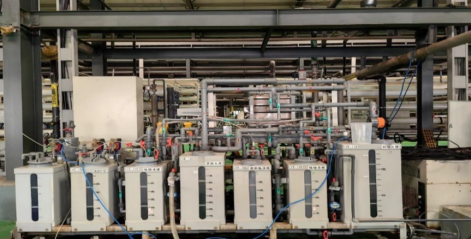
ED experiment
BICHEM’s Membrane-coupled ED platform
In response to this industry trend, BICHEM has developed an integrated membrane-coupled ED technology route. Its core objective is not simply to improve the efficiency of a single process step, but to achieve a more direct target: controlling lithium loss throughout the entire process to below 0.5%. This means that more lithium resources are retained in the final product rather than being gradually lost during separation, concentration, and purification. BICHEM’s membrane-coupled ED technology platform organically integrates membrane separation, ion migration control, and deep impurity removal to enable highly efficient enrichment and purification of lithium resources from salt lake brines.
During the front-end membrane pre-treatment stage, the system first removes suspended solids, colloids, and impurities such as silica, magnesium, and calcium that may destabilize the process. The significance of this step extends beyond feed purification. By reducing feed fluctuations, it ensures that subsequent separation processes operate under stable boundary conditions, thereby minimizing lithium deviation and unnecessary losses caused by system disturbances at the source.
After entering the ED enrichment unit, lithium ions undergo directional migration under the influence of an electric field. Unlike conventional diffusion-based separation driven by concentration gradients, this process employs selective membrane structures and optimized flow channel designs to ensure that lithium ions continuously migrate along predefined pathways, reducing non-target losses caused by random diffusion and retention.
At the same time, impurity ions such as boron and silica are continuously retained and discharged from the system, creating a cleaner migration environment for lithium ions. This helps reduce hidden consumption resulting from side reactions and competitive ion migration.
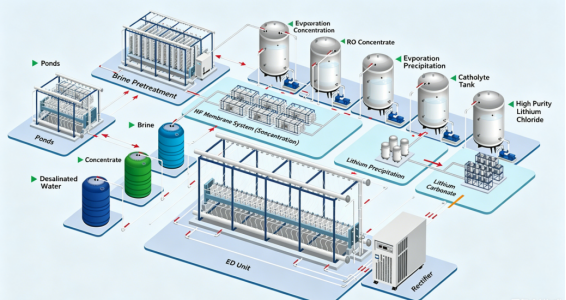
BICHEM’s ED coupled membrane lithium extraction process flow
Significance for industrial-scale salt lake lithium extraction
Compared with conventional membrane-based processes, membrane-coupled electrodialysis effectively removes critical impurities such as boron and silica at the front end, preventing competition between impurity ions and lithium ions during separation. This reduces unnecessary lithium loss within the system at its source, enabling the process to maintain an ultra-low lithium loss rate of approximately 0.5%. On this basis, the operating conditions of downstream lithium extraction systems are comprehensively optimized. Since impurities are effectively intercepted upstream, subsequent adsorption, extraction, and crystallization units operate more stably, reducing hidden lithium losses throughout multi-stage processing. At the same time, the risk of operational fluctuations caused by membrane fouling and scaling is significantly reduced, enabling long-term stable and continuous operation.
For customers, this translates into three direct benefits. First, the closed-loop utilization efficiency of lithium resources in brine is significantly improved, reducing resource losses during discharge. Second, dependence on high-loss process steps such as conventional resin adsorption is reduced, thereby lowering secondary lithium losses throughout operation. Third, enhanced system stability provides greater control over lithium retention during long-term operation. Through overall process optimization, the system maintains stable low-loss performance while achieving higher resource utilization efficiency and smoother operational performance, enabling salt lake projects to sustain stable economic returns even under complex brine conditions.
Conclusion
Leveraging extensive engineering experience and continuous technological innovation, BICHEM integrates membrane technology, ED, boron removal, silica removal, and downstream lithium extraction processes into a unified solution. The Company provides customers with comprehensive solutions covering brine pre-treatment, ion separation, resource enrichment, impurity removal, and product purification. The membrane-coupled ED platform represents a technological pathway fundamentally centered on retaining more lithium within complex systems. Through the synergistic effect of membrane separation and electrically driven ion migration, unnecessary lithium loss within the system is reduced to approximately 0.5%, thereby redefining the efficiency boundary of lithium extraction from salt lake brines at its source.
