


Driven by the explosive growth of the energy storage sector, lithium salt manufacturers have ramped up production capacities to meet the surging demand for lithium carbonate. Against this backdrop, boron impurities in brine systems have emerged as a critical bottleneck restricting the grade upgrade of lithium salts. Though boron exists in brine at trace concentrations, it exerts a profound adverse impact on the purity of finished lithium salt products. During lithium precipitation reactions, residual boron impurities directly disrupt crystal formation, resulting in substandard lithium carbonate purity and fluctuating impurity parameters. Such products fail to meet raw material access standards for power batteries and energy storage lithium-ion batteries. To tackle boron removal challenges, most industrial projects initially adopt conventional processes including chemical precipitation and resin adsorption. Yet prolonged commercial operation has exposed prominent drawbacks of these technologies. The chemical precipitation method requires continuous dosing of massive chemicals, driving up operational costs substantially while generating large volumes of boron-laden hazardous waste that imposes heavy burdens on environmental treatment. The resin adsorption process, by contrast, demands frequent acid-alkali regeneration, featuring cumbersome operation and maintenance procedures and high consumable loss, making it incompatible with current large-scale continuous production at ten-thousand-ton annual output levels. Many enterprises have invested in complete sets of membrane system equipment for boron removal, drawn by the high efficiency and eco-friendly merits of membrane technology. However, they overlook the unique working conditions of salt lake brine characterized by high salinity and high magnesium-lithium ratio, and mechanically apply general water treatment processes. This practice consequently triggers recurring operational issues such as rapid fouling of membrane elements, unstable boron concentration in product water, and frequent shutdowns for chemical cleaning. As a result, the boron removal unit turns into a capacity bottleneck of the entire lithium extraction production line.
Global project implementation experience of BICHEM has proven that premium membrane equipment merely serves as the production foundation, while tailor-made process technologies hold the key to stable boron removal and long-term efficiency improvement. As a solution provider specializing in salt lake lithium extraction, BICHEM concentrates on exclusive brine lithium extraction scenarios and delivers full-process technical services for membrane-based boron removal, covering process planning, working condition adaptation, parameter optimization and technical revamp of existing production lines. The company breaks down the technical barriers linking the boron removal section with upstream and downstream processes including DLE adsorption-extraction, MVR concentration and lithium precipitation crystallization, fundamentally resolving a full range of production issues induced by excessive boron impurities from the process perspective.
Unlike the generalized services offered by conventional water treatment enterprises, all process solutions developed by BICHEM adhere to the principle of “one tailored strategy for one salt lake”. In accordance with raw brine water quality, magnesium-lithium ratio and initial boron impurity concentration of each project, combined with on-site production load and environmental conditions, we design customized multi-stage combined membrane refining processes matched with proprietary pre-treatment systems. Suspended solids are filtered in advance and scale-prone calcium and magnesium impurities are eliminated to mitigate membrane surface fouling at the source. This significantly extends the continuous operation cycle of membrane equipment and thoroughly addresses prevalent industry pain points such as rapid flux decline and frequent chemical cleaning. Meanwhile, critical operating parameters including operating pressure, system recovery rate and pH control range are fine-tuned precisely. While stably maintaining boron levels in product water to meet production standards for battery-grade lithium salts, the solution maximizes water resource recycling efficiency.
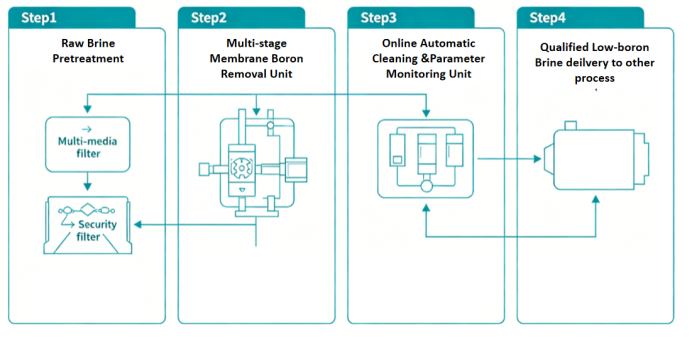
Fig.1 General Boron Removal Flow
For existing lithium extraction production lines, BICHEM provides lightweight process renovation and upgrading services. Customers are not required to replace original membrane hardware. By conducting process diagnostics to restructure operation logic, optimize supporting pre-treatment procedures and adjust segmented operating parameters, fluctuations in product water quality and excessive flux attenuation can be rapidly mitigated. The boron removal section achieves cost reduction and efficiency gains with minimal renovation investment, enabling a quick return on retrofit expenditure. In addition, we coordinate load matching across the entire lithium extraction line to eliminate overcapacity or insufficient processing capacity in the boron removal unit, remove capacity bottlenecks throughout the whole process, and sustain consistent and uniform quality of lithium carbonate products in downstream sections.
Compared with conventional boron removal processes, the optimized solutions developed by BICHEM are better aligned with the large-scale and eco-friendly production demands of modern salt lake lithium extraction. The system supports fully automatic continuous operation, drastically cutting chemical dosage and labor O&M costs while generating minimal hazardous waste, fully complying with stringent environmental compliance standards at home and abroad. Moreover, it enables seamless integration with full-process procedures including DLE lithium extraction, MVR evaporation concentration and lithium precipitation crystallization, breaking capacity barriers between individual sections to deliver steadier operation and balanced output across the entire production line.
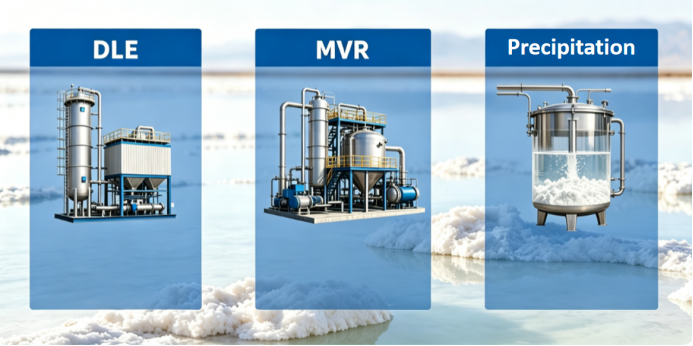
Fig.2 Core Processes for Lithium Extraction
With long-term expertise in the global salt lake lithium extraction industry, BICHEM leverages extensive global project delivery experience and top-tier industrial partnership resources to consistently prioritize process innovation and scenario-specific customization. Amid intensifying homogeneous competition within the lithium battery sector, stable lithium salt product grade constitutes the core competitiveness of manufacturers. Our customized membrane-based boron removal process technology addresses the refining bottlenecks of salt lake lithium extraction, supporting steady mass production of high-quality battery-grade lithium carbonate for every salt lake project. We empower clients with proprietary technologies to secure product premium margins and sustainable long-term profitability.
